

Learn Online
No memorization. No practice. No homework. No long hours.
That is the whole method. Classes are live and online — Google Meet plus our own platform, taught in small batches inside a shared Jupyter notebook. Take the grind away and what remains is understanding: students learn faster and better, keep almost perfect recall, and after a few years typically work a couple of grades above school level.
Join the live class
12 to 16 one-hour sessions a month, live with a mentor in a batch of 3–6 — and that is the entire scheduled commitment. Small enough that every child reasons out loud, and is heard.
Derive the concept
Nothing is dictated to be memorized. On the shared board the batch builds each idea from what it already knows, step by reasoned step, until every student can rebuild it alone.
Walk out free
No homework follows the hour. What remains — checking that a concept holds — takes minutes on the platform, not evenings at a desk.
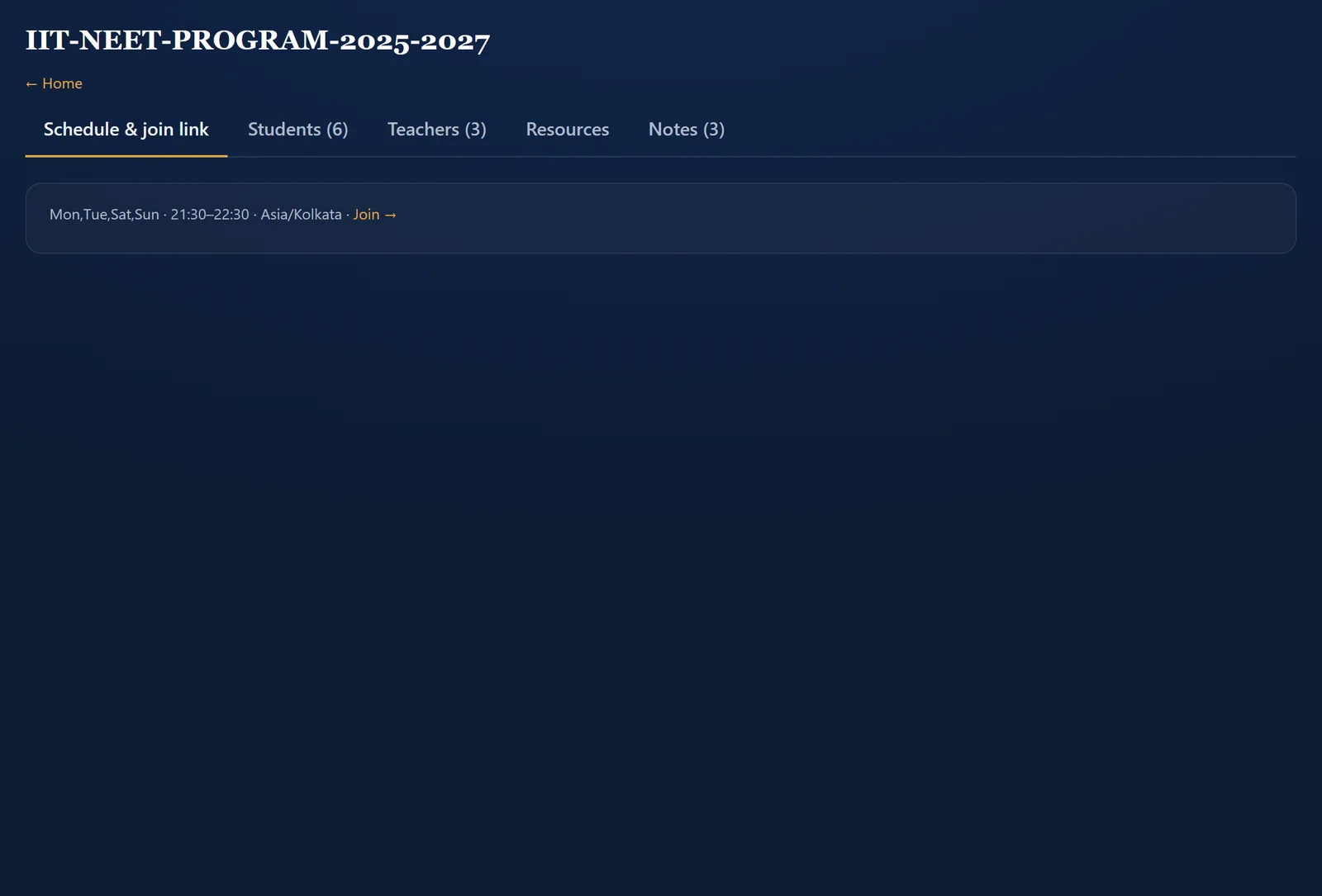
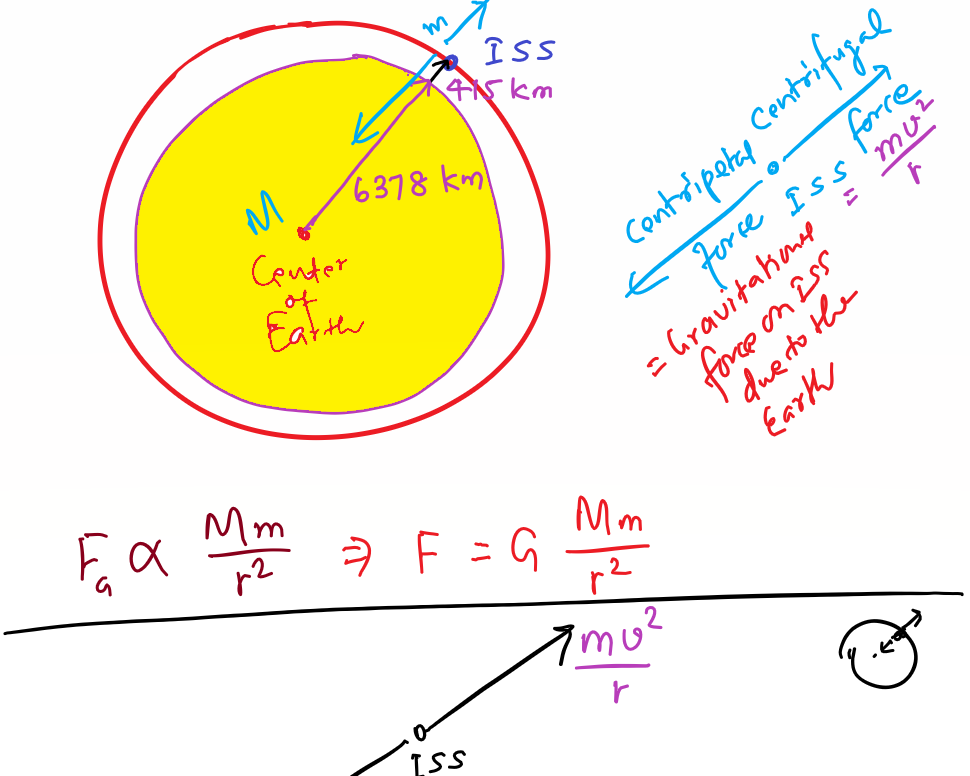
A notebook, not a worksheet
What a student can derive, they cannot forget. So the mentor never hands down steps — they turn the batch's own reasoning into running code and live diagrams, and the rare topic that slips months later is re-derived in minutes, not re-crammed for weeks.
- One shared screen — code, sketches and notes grow together, live, as the reasoning unfolds.
- Voice support reads prompts aloud, so even our youngest students can follow and answer.
- Programming is a medium, never the goal — it makes abstract ideas visible enough to reason about.
Attention isn't a stopwatch
A batch of five doesn't mean your child gets a fifth of the hour. Time in our classes isn't divided — it's shared.
Taught from where they are
The teacher doesn't split the hour mechanically. Each child is engaged from where their understanding actually is — not from a script, and not from a timer.
One question, everyone's lesson
Much of the hour is shared reasoning: one student's question becomes everyone's lesson, and a few peers thinking aloud together sharpen each other's reasoning.
Why three to six?
It isn't one-on-one by design: it takes a few minds to explore, question and challenge each other, and that is how the truth gets discovered. Too few and there's less spark; too many and it turns to noise — three to six is the deliberate sweet spot.
Checking understanding, not homework
We assign no homework and no practice grind, because understanding needs checking, not repetition — one fresh question a student has never seen proves a concept better than fifty copies of the same sum. The platform exists to ask exactly those questions.
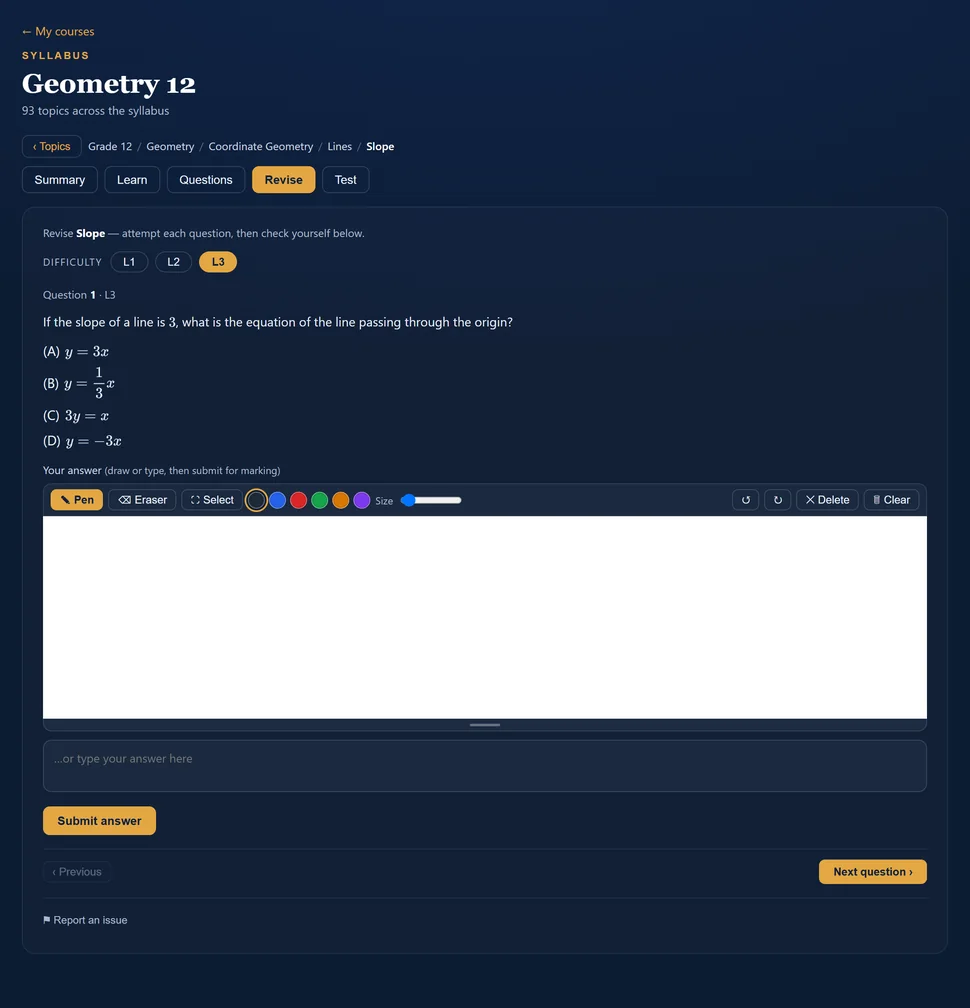
Fresh, unseen questions
Generated questions practically never repeat, so there is no bank of answers to memorize. Typed or handwritten on the canvas, every answer is marked instantly.
Revise, Test, Retest
Revise gives graded feedback with nothing recorded — a safe first check. Test saves the attempt: score, time and the child's own working. Retest takes any past attempt and spawns a fresh, related question — never the one your child remembers.
A record you can open
Every attempt is kept per topic — the exact question, your child's answer including the handwriting, and the marking. A stumble isn't failure; it's the method finding what the next live class should rebuild.
The recording is kept. The board becomes notes.
Nothing from the hour has to be reconstructed from memory. Every session's recording lands in the student's own folder — and the day's whiteboard is converted into typeset, searchable study notes on the platform.
Revision without re-memorizing
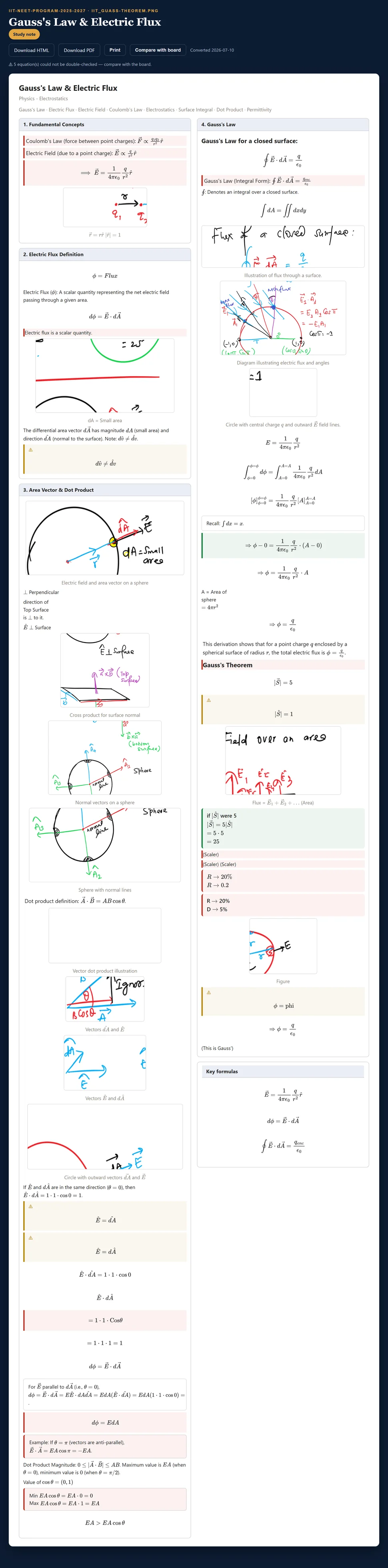
These are pages from real sessions, not stock illustrations. Because each note records a derivation rather than a list of facts, revising means reading the reasoning back — not cramming it in again.
- One thread ties subjects together — in these very notes, the same calculus connects rate of reaction, radioactivity and orbitals.
- Every set comes with a dense cheat-sheet version and a PDF download; a batch's notes can be combined into one revision sheet.
- Notes are visible only to your child's batch — a growing personal map of everything they have built.
The topper paradox
Every hour above is shaped by what first sessions keep revealing — gaps at the child's own grade level, even in toppers. That is the topper paradox, told in full on our About page; we rebuild from there, toward a student who can handle problems they have never read before.
From hello to the first class
No entry test, no prerequisite and no card details — we start every topic from foundations, so your child can join at any grade from Grade 2 up.
Say hello
Message us on WhatsApp or email with your child's grade, time zone and goals — that's all we need.
Take a free intro session
Your child meets the mentor live on the whiteboard. This is usually where the first gaps show — and where you watch us rebuild one instead of drilling past it. Then you decide.
We set everything up
If you join, we place your child in a batch that fits their level and time zone, and set up their platform account. Nothing to install.
No memorization. No practice. No homework. No long hours. Come see what remains.
We mentor students from Grade 2 to Grade 12 and AP — and college students and professionals for advanced topics — live, online, one derived idea at a time. Reach us at info@xcelvations.com or WhatsApp +91 94414 00202.